
How to Find People in Woodstock
Start with the fact that can be checked most precisely. An owner name or street address belongs in the Cherokee County property search. A former owner belongs in the deed index, where grantor and grantee names trace transfers. A lawsuit or criminal case belongs in the county court party search. Older residents may appear instead in obituaries, newspapers, yearbooks, cemetery files, or family-history collections held by the library and local archives.
A Woodstock mailing address can fall outside the incorporated city. Confirm the parcel and jurisdiction before asking City Hall for a record. When a web index stops short, use the named office, counter terminal, written request, or archive collection rather than treating an empty online result as proof that no record exists.
- Search the assessor by owner, address, or parcel and save the parcel number, legal description, and deed references.
- Use those names in the Landmark deed index as both grantor and grantee, widening the date range when needed.
- Check Cherokee court cases by party name, then open the case row for dates, parties, judge, and docket posture.
- For family history, move from probate and death records to obituaries, newspapers, directories, and cemetery sources.
- Ask the correct custodian for an existing record that is not searchable online.
Woodstock Records Offices by Role
Most permanent name-indexed records for Woodstock are county records kept in Canton. The Superior Court clerk maintains deeds, liens, plats, and trial-court files. Probate Court handles estates and marriage licenses. The assessor connects owners to parcels. Woodstock's city clerk keeps municipal agendas, minutes, contracts, ordinances, deeds, easements, elections material, and other city-created files. The detailed access rules and request routes are organized on the Woodstock public records page.
Cherokee Clerk, Deeds and Records
90 North Street
Canton, GA 30114
678-493-6511
Cherokee Probate Court
90 North Street, Suite 340
Canton, GA 30114
678-493-6160
Landmark Links Woodstock Names
The Cherokee County Landmark official-records index is a strong next stop after a property search. It organizes deeds, security deeds, liens, plats, and related instruments around parties and recording details. Search a person in both roles: a grantor gives or transfers an interest, while a grantee receives one. A direct book-and-page search is useful when an assessor card already supplies that reference.
| Landmark mode | Best use | What narrows it |
|---|---|---|
| Name | Follow a person's recorded property trail | County, date, party role, instrument type |
| Book and page | Retrieve a known citation | Exact book and page values |
| Subdivision fields | Find instruments tied to a platted lot | Subdivision, unit, block, and lot |
The public landing page does not state the exact first online year for Cherokee County. Older material may require the clerk's Canton counter or a manual index. The official search screen shown below makes the county index the source, not a commercial profile assembled from other data.
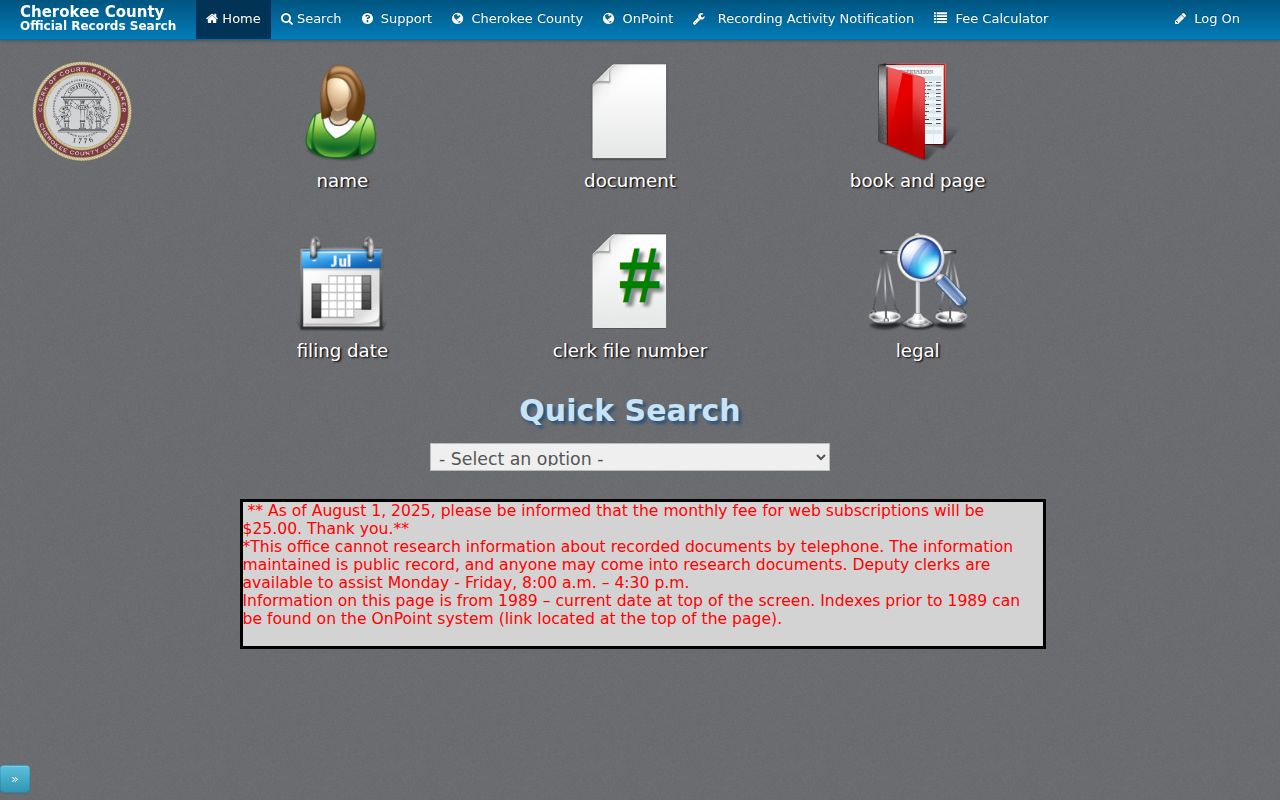
The image helps identify the correct official portal before a name, document reference, or legal description is entered.
Woodstock Property Search Trail
The assessor turns an address into structured identity evidence. Its parcel record can show the owner, situs address, mailing address, parcel number, values, acreage, improvements, sales, and deed references. A situs address is the physical location; a mailing address is where the tax notice goes. They may differ, especially for a nonresident owner.
Open the Cherokee property owner search, try the street without extra unit or direction text, and retain the parcel number even if the owner's name is common. Then carry the deed citation into Landmark. City and county GIS layers can resolve whether a Woodstock postal address lies inside city limits.
The official assessor interface provides the name, address, and parcel routes used in that workflow.
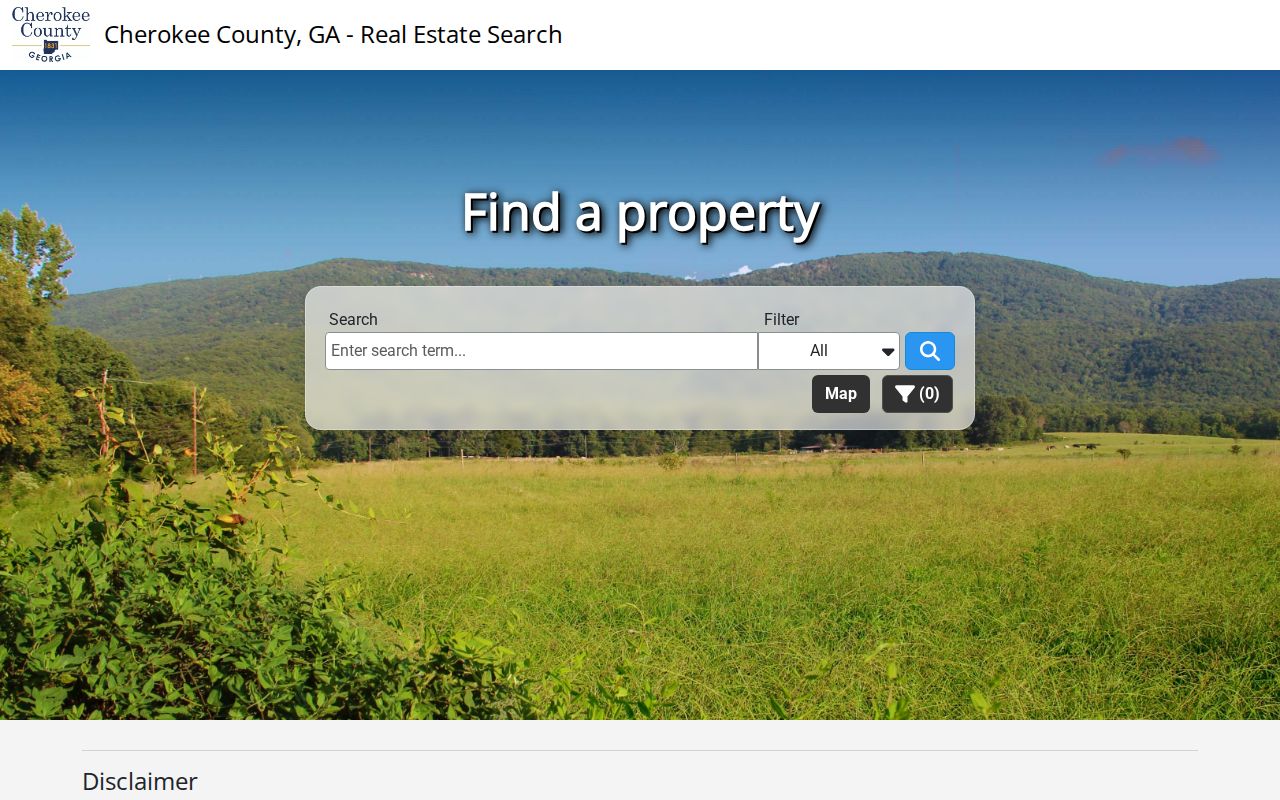
That parcel key is often more reliable than a name alone when two owners share similar names.
Search Woodstock Court Records
The Cherokee court case search accepts a case number, party name, or child-support-enforcement number for Superior, State, and Magistrate matters. Expanding a case row can reveal parties, court dates, the judge, and overall docket posture. A docket is the chronological register of filings and events, not necessarily the full text of each pleading.
Sensitive pleadings are withheld online, and sealed, juvenile, adoption, or otherwise confidential material is not opened by a general name search. The authentic full file remains with the clerk. Woodstock Municipal Court handles city ordinance and traffic matters, but the city publishes no comprehensive party-name index; contact its clerk for inspection or copies.
| Court | Covers | Name Search | Access |
|---|---|---|---|
| Cherokee Superior, State, Magistrate | Civil and criminal cases | Party, case, or CSE number | Online docket; clerk for file |
| Woodstock Municipal Court | City ordinance and traffic | No public party index verified | Municipal court clerk |
| Northern District of Georgia | Federal cases | PACER | Account and usage fees |
The county clerk's case-search page pictured here is the right starting point for county trial-court names.
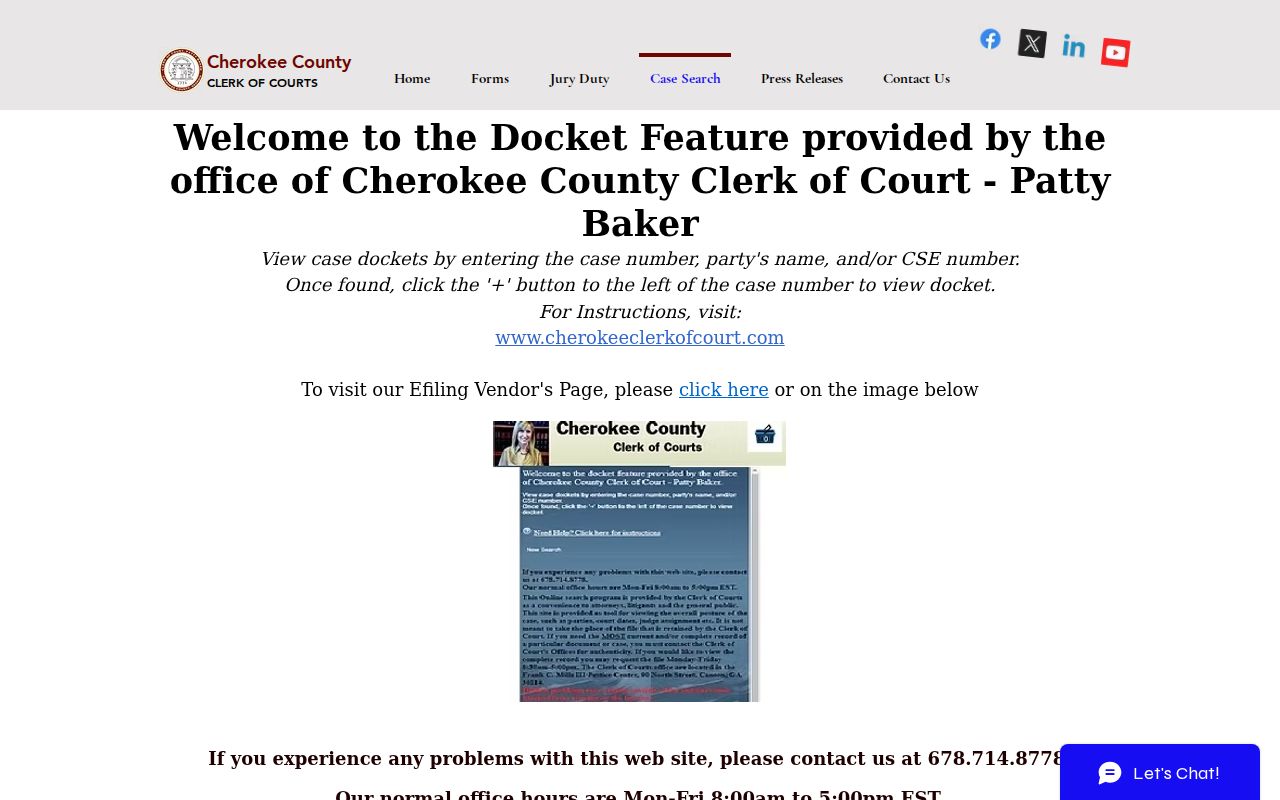
Its result should be treated as a case locator, with the clerk's file used when complete or certified material is needed.
Woodstock Vital Records Routes
Georgia DPH keeps statewide birth and death records from January 1919 and marriage records for a limited mid-century period. Cherokee Probate Court handles marriage years outside the state span, while a divorce decree stays with the Superior Court that granted it. Woodstock also has a state-listed vital-record counter at the Cherokee County Health Department, 7545 Main Street, Suite 100.
Modern vital records are not a browseable people directory. Georgia law restricts certified birth service and requires a direct and tangible interest for birth and death copies. Official county copies and indexes for deaths, marriages, and divorces have different public-access treatment. For historical research, birth records transfer to Georgia Archives after 100 years; death, marriage-application, divorce, dissolution, and annulment records transfer after 75 years.
- Certified copy
- An office-issued copy carrying official certification for formal use.
- Index
- A locator showing that a record exists, often without the full document.
- Decedent
- The person who died and is named in a death or probate record.
Woodstock Boundaries Change Records
A Woodstock postal label does not settle which government made a record. The city's administrative-area GIS maps city limits and council wards, while its historical ordinances layer tracks annexations, deannexations, zoning, variances, and conditional-use approvals from 2000 forward. Those layers can explain why an address appears in county records but not in a city permit or police file.
Use the parcel first, then compare its jurisdiction with the date of the event. A later annexation does not make an older county-created record a Woodstock city record. This geography check prevents one of the most common dead ends in a local search.
Woodstock City Records at Source
The city clerk maintains council agendas and minutes, contracts, resolutions, ordinances, deeds, easements, open-meetings records, proclamations, and historical city material. Woodstock Police Records is the fallback for city incident or accident files, while Municipal Court keeps its own ordinance and traffic cases. These are separate from the county clerk's deeds and trial-court records.
The Woodstock City Clerk page identifies the office responsible for city administrative files.
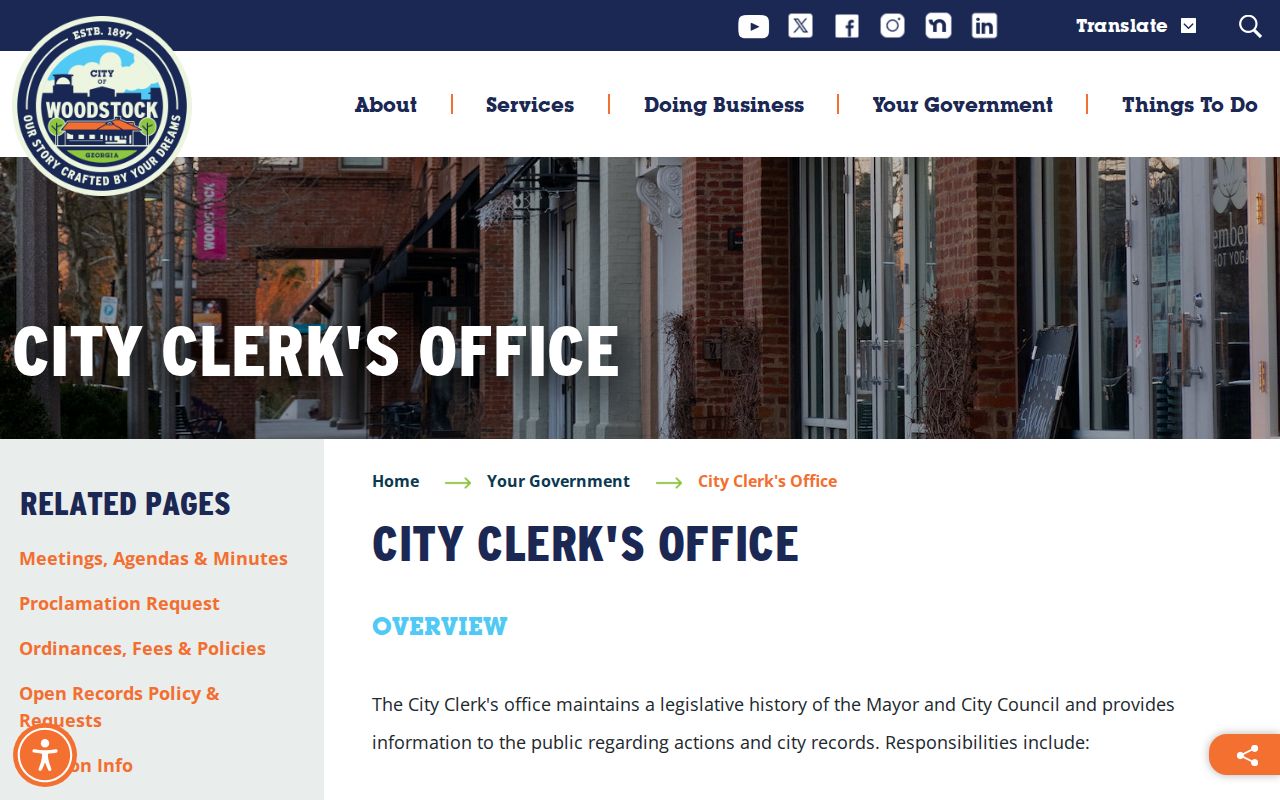
That distinction matters when an address is inside the city and the sought event involved a Woodstock board, contract, permit, or ordinance.
Open Records Beyond Search Screens
Online indexes are only one access channel. Cherokee County routes general administrative requests through NextRequest. Court records go directly to the appropriate clerk, vital records follow DPH or Probate rules, and Woodstock-created records go to the city. Georgia's Open Records Act requires a response within three business days when records are available, but an agency does not have to create a new list or report.
The Cherokee request portal provides the county route for a request that does not belong with a court or specialized custodian.
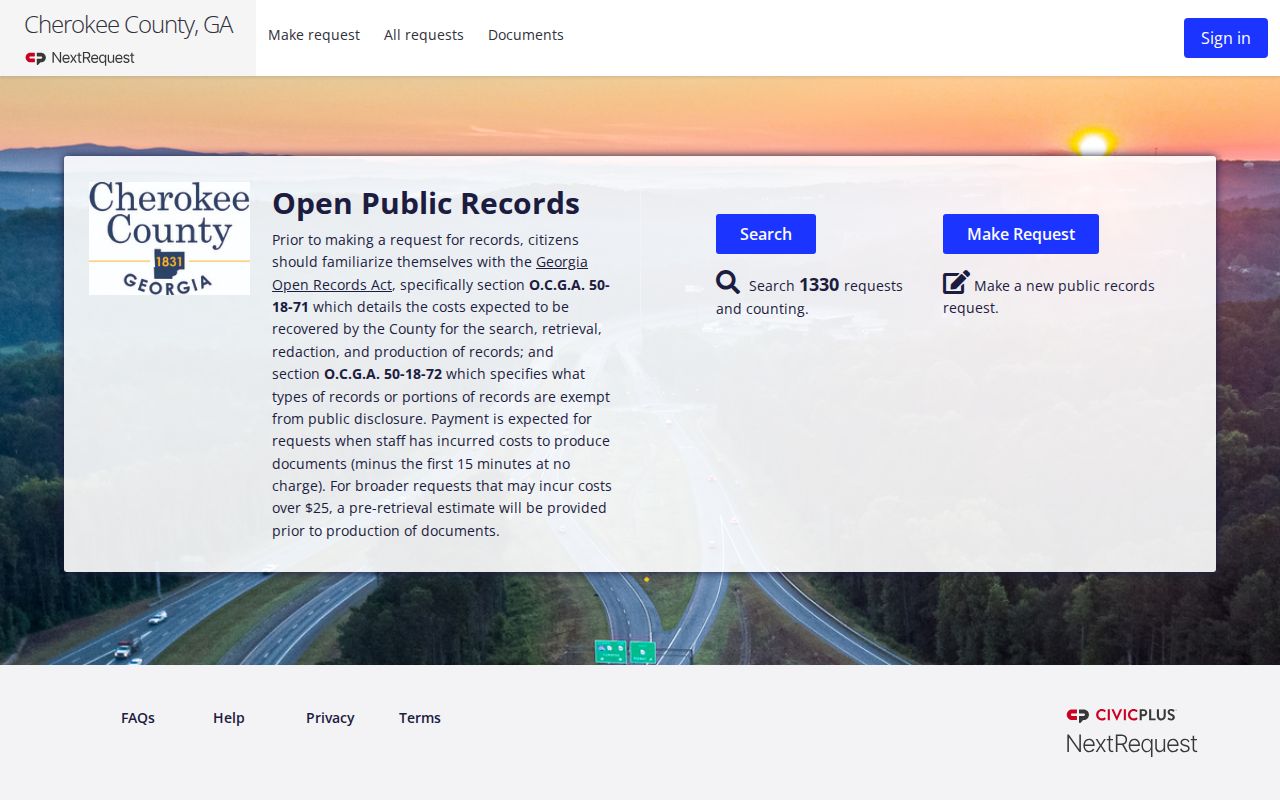
A narrow date range, record type, subject name, and existing file identifier make a request easier to route and may reduce search cost.
Business and License Name Search
A person connected with a company may appear in the Georgia Business Search through an entity name, control number, officer, or registered-agent trail. Professional boards use the state license verification system for license type, number, status, and public discipline where available. These sources verify a specific public role; they do not prove that every same-name result is the same person.
The corporations search screen pictured below helps separate a formal entity filing from an informal web listing.
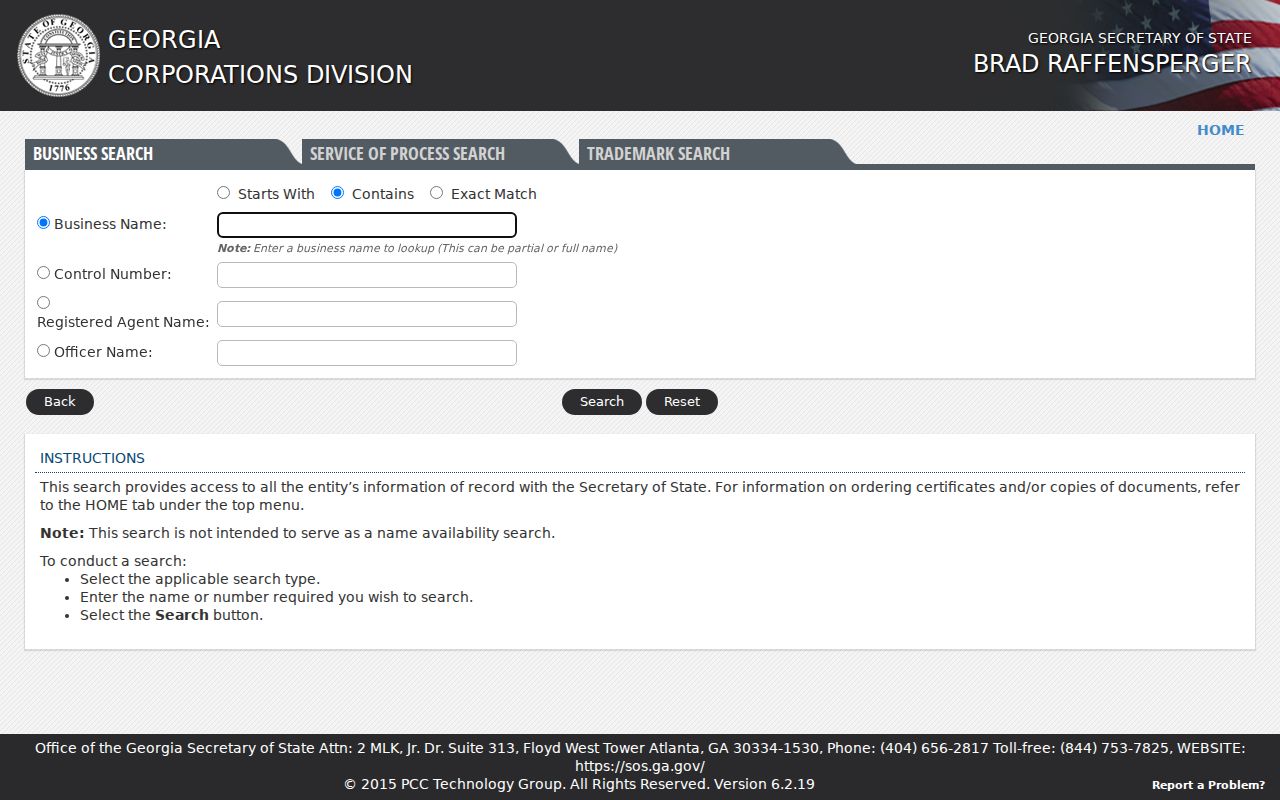
Match the entity's status, dates, and registered office with parcel or court evidence before drawing an identity conclusion.
Woodstock History Finds Former Residents
Current databases are weak tools for someone who lived in Cherokee County decades ago. History Cherokee's research archive holds family files, photographs, maps, books, church and cemetery material, military records, vertical files, surname files, directories, and newspapers. The Sequoyah Regional Library's Woodstock branch adds catalog and local-history access, while Georgia Historic Newspapers provides a searchable newspaper route.
The History Cherokee research collection offers the local context that a modern address index cannot.
Search a surname with an address, church, school, cemetery, military unit, or relative to reduce false matches.
Official Records Beat Aggregated Profiles
Commercial people-finder profiles may combine public and commercial data, but the result can lag corrections, merge people who share a name, or hide where a fact came from. Official indexes show the custodian and usually supply a parcel, case, book-page, license, or entity key that can be checked.
| Source type | Strength | Limit |
|---|---|---|
| Official index | Traceable to a named custodian | May show only a locator, not an image |
| Counter or written request | Can reach files absent from the web | May take time or involve lawful fees |
| Commercial compilation | Combines many hints quickly | May be stale, merged, or poorly sourced |
Use a compilation only to form a hypothesis. Confirm each material fact with the office that created the underlying record.
Custody and Registry Lookups
The Cherokee Jail List, Georgia Department of Corrections finder, federal Bureau of Prisons locator, and Georgia registry answer different questions. A jail entry can show a name, booking ID, booking date, agency, charge, and bond. The state finder covers Georgia prison custody, while the federal locator handles federal custody records from 1982 forward.
Custody status changes quickly. An arrest is not a conviction, a charge is not a final disposition, and a release date can change. Check the responsible agency and court docket before relying on a match.
Unclaimed Property Reconnects Names
The Georgia Unclaimed Property Program is an official name-search route for money or property turned over after an account lost contact with its owner. A possible match can support a family or estate search, but the state claim process requires proof. It should not be confused with messages demanding an advance payment to release funds.
For a deceased owner, pair the state result with Cherokee probate filings, estate notices, deeds, and obituaries. Those records may identify an executor, administrator, heir, or later property transfer without relying on an unsourced profile.
Name variations matter here. Search a married name, earlier surname, middle initial, and the name of a family business when the evidence supports each form. If a likely result points to an old Woodstock address, resolve that address to a parcel and compare the ownership dates with probate or deed filings. The aim is not to force every result into one identity. It is to build a dated chain in which each office supplies one checkable part.
An estate trail can also lead in the other direction. A probate caption may provide the decedent and representative, a deed may show the estate conveying land, and an obituary or cemetery record may distinguish relatives with similar names. Keep copies of the record keys, not just screenshots of search results, so the clerk or archive can locate the same material later.